
*koru = a general word that is used to describe any piece of jewelry (Finnish noun)
Making jewelry isn’t difficult. You just place beads on a thread and connect the loose ends. There you have a long necklace. But if you want to make yourself a bracelet or a short necklace, you need to learn how to end it. It isn’t that difficult either.
How to end a koru based on beading wire

Ending a beading wire koru begins like this: Place one or two crimp beads on the wire. One is fine, two is better. After crimp beads, add a clasp. Then take the wire back again through crimp beads. Practice has shown that a small loop looks prettier than a big one.

Here I have used only one crimp bead. When your loop size looks nice, crimp the crimp bead with pliers. Pliers can have smooth or roughened surface, I prefer these. After the crimp bead has been properly crimped, cut the extra wire away.

For a nice finishing touch you need also a crimp bead cover. It’s a hollow shell that is closed onto the crimp bead. Again, it’s a matter of opinion and metal material what kind of pliers you wish to use. Smooth pliers don’t scratch and some soft materials require using them. They can also be slippery and since this particular bead (crimp bead cover) is not very co-operative sort, you get a better grip with roughened pliers. Just be careful, they may scratch the bead.

Here we have a nice ending. The crimp bead cover looks just like any other bead. If you look closely, you’ll see a small seam. Be prepared that you need to try this phase a few times before it goes well.
Ending a chain koru

Chain-based koru has lighter appearance than the one on beading wire. The way to attach the clasp is also different from wire.

The picture here shows you steps of making a connection between chain and a clasp. You need a small bead (about 3-4 mm) and a head pin from which the head has been removed. Place the bead in the middle of the pin. Then bend the pin with round-nose pliers from both ends so that it makes a letter S. Attach the clasp to one end and close the loop. Then place the end of the chain to the other end and close the loop. And there you have it!
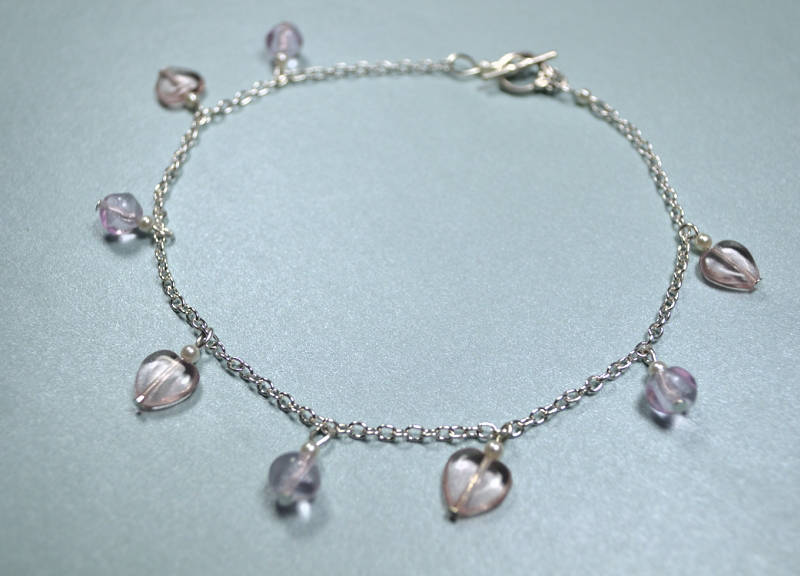
A finished koru.
Ending a seed bead koru
There are three ways to end a seed bead koru: glue, wire protector and a handmade loop.
Ending the threads with glue

Here you need an item called clamshell. It has a hole in the bottom, and you need to take the thread(s) through that hole.

Make a knot, or if you have several threads, tie them together. You can use a pin or a needle to slide the knot and the clamshell as close to the last seed beads as possible. In order to prevent the knot from escaping through the hole in the bottom you need to either make a big big knot or add a seed bead in the middle of the knot. It all about size.

Pour some glue on a piece of cardboard. Use a toothpick or a match to dose a drop of glue inside the clamshell.

Close the clamshell carefully with pliers. cut the thread ends and leave the glue to dry. Let it dry out over night. Then you can add hooks or a clasp. The biggest advanvatage in using glue is the ease of workflow. It makes it simple for a beginner. There’s no thread to be ended.
Wire protector

If an idea of glue doesn’t appeal to you and you have wire protectors at home, you can use them as a bridge between a clasp and a koru. To be honest, I can’t see the point in protecting wire but the thread needs some protection or it will slowly decay and eventually snap.

The basic idea is simple: thread goes through the wire protector twice and returns its journey through seed beads. The problem with wire protector is that in smaller models, like I have here, thread can penetrate the protector only twice. As you see, there’s an open ”gutter” and tunnels at each end. When I use this method, I always hope I had three hands but it’s a nice way to attach a clasp to a koru. To end the loose thread ends, swirm your way through the koru, change direction a couple of times and snip the rest when you feel like it.
Making a loop

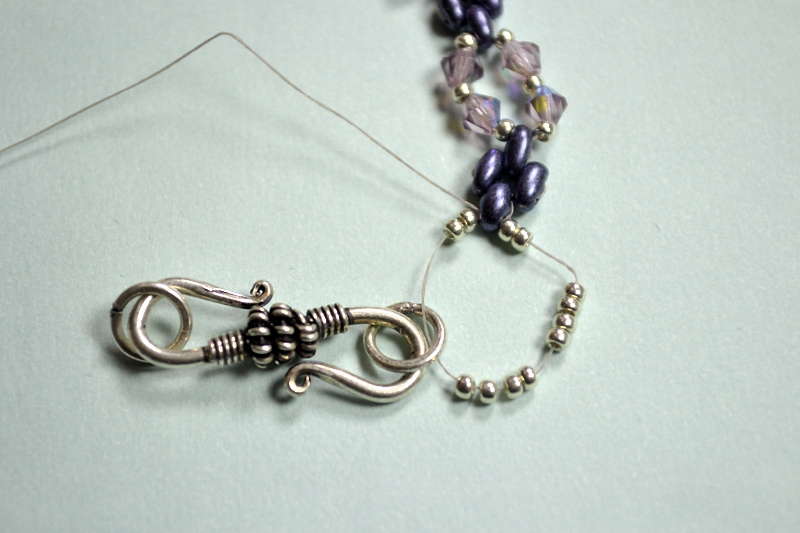
Making a loop is firmer way to attach a clasp to a koru than using a wire protector. Take 6-8 seed beads and divide them in two sets. First, pass your thread through one set of beads, add the clasp and then the rest of the beads.

The greatest benefit of this method is the firmness. You can go through the seed bead loop over and over again, at least five times. Ending the loose end of the thread goes just like I described with wire protectors: go back, go round, change direction and cut the rest.
Woohoo, you learned a new word and got a lot of useful information. Now you must wonder how you have managed to live all these years without the word ”koru”. There has so much talk of endings that there’s only one way ending this story: THE HAPPY ENDING!
